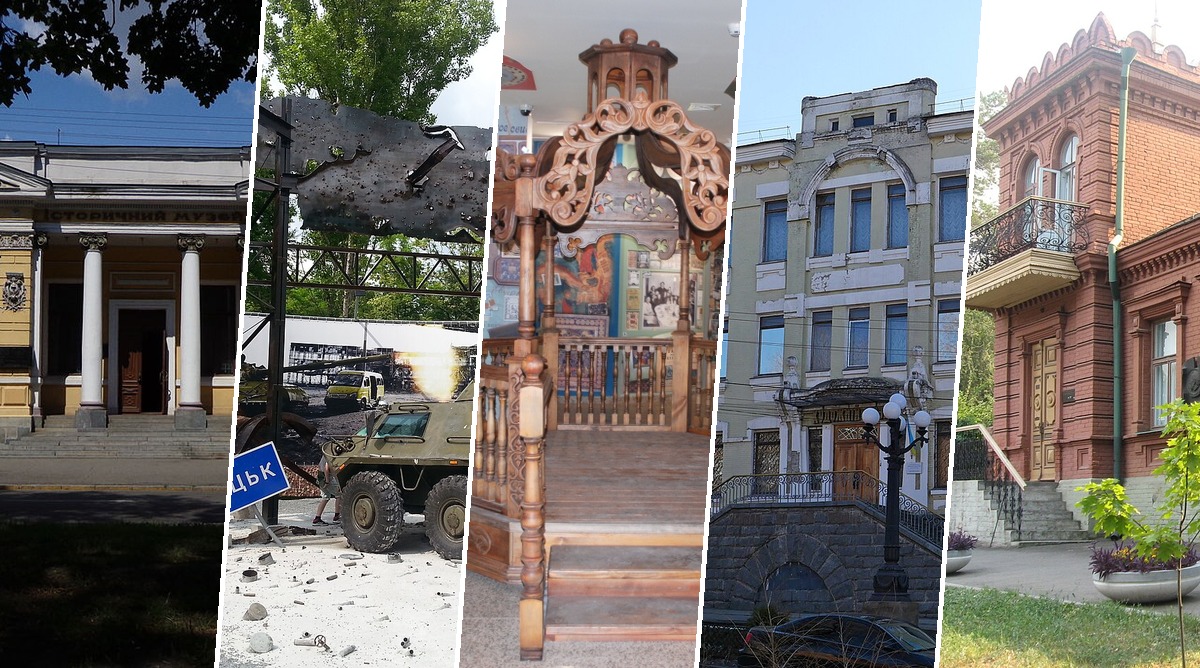
Dnipro is often seen as a city of factories and a wide riverside embankment, but behind that façade lies a remarkably rich museum map. In a single day it is possible to travel from the Scythian steppe to the heart of the Battle for the Dnipro, from Aivazovsky's canvases to the cosy study of a man who devoted his whole life to the Zaporozhian Cossacks.
Most of the museums are concentrated in the city centre, along Yavornytsky Avenue and around Shevchenko Park, so the route is easy to walk.
Under martial law, museums may change their opening hours, so it is worth checking the latest information on their official pages.
1. Dmytro Yavornytsky Dnipropetrovsk National Historical Museum

Dmytro Yavornytsky Historical Museum. Photo: Roman Minchyn, CC BY-SA 4.0, Wikimedia Commons
Address: 16 Dmytra Yavornytskoho Ave.
Locals proudly call this museum the heart of the city, and for good reason: it is one of the oldest museums in Ukraine. Its soul was Dmytro Yavornytsky, a historian who quite literally lived and breathed Cossack antiquity and assembled an extraordinary collection here.
Visitors are greeted at the entrance by stone babas, stern Scythian and Polovtsian idols that stood in the steppe for centuries. Inside, a true treasury unfolds: from a statuette of an Egyptian pharaoh to Cossack relics and the carriage in which Catherine II travelled south. The collection is so vast that it is almost impossible to see everything in one visit.
2. “Battle for the Dnipro” Diorama

“Battle for the Dnipro” Diorama. Photo: Cambronn, CC BY-SA 3.0, Wikimedia Commons
Address: 16 Dmytra Yavornytskoho Ave.
Next door is a diorama that transports visitors straight into the heart of battle. It is one of the largest dioramas in Europe: the canvas surrounds the viewing platform almost on all sides, and the line between painting and reality gradually fades.
The artists depicted the crossing of the Dnipro in 1943 and filled the foreground with remnants of fortifications, weapons and boats. Light and sound complete the effect of presence: it feels as if a command is about to ring out. Outside the building, tanks, a “Katyusha” rocket launcher and an anti-aircraft missile system stand in the open air.
3. Museum of the Modern Russian-Ukrainian War

Museum of the Modern Russian-Ukrainian War, “Destroyed Airport” exhibit. Photo: Museum1849, CC BY-SA 4.0, Wikimedia Commons
Address: 16 Dmytra Yavornytskoho Ave.
This museum tells the story of the war that is still going on. It was created by soldiers and volunteers themselves back when the war was called the ATO, and the collection has been growing ever since.
The open-air exhibition “Roads of Donbas” features a real concrete checkpoint, military equipment and road signs from Donetsk highways. Inside are the stories of people: soldiers, medics, chaplains, journalists and volunteers. The strongest impression is left by the Hall of Bright Memory with hundreds of portraits of fallen defenders from Dnipropetrovsk region. Admission is free, but this museum deserves an unhurried visit.
4. Dnipro Art Museum

Dnipro Art Museum, main façade. Photo: Olebesedin, CC BY-SA 4.0, Wikimedia Commons
Address: 21 Shevchenka St.
The art museum has a completely different mood. It holds works by Aivazovsky, Repin, Levitan, Pymonenko and other classics usually expected only in the galleries of the capital.
Among the gems of the collection are “In the Studio” by Marie Bashkirtseff, in which young women artists focus on drawing a model, and a study for “The Last Supper” by Nikolai Ge. A special place belongs to the works of Mykhailo Sapozhnikov: this Symbolist was born in Katerynoslav, and his canvases have a distinctive, slightly mystical mood.
Please note: the museum is currently closed. In spring 2026, a Russian strike blew out all the windows of the building. Fortunately, the collection was not damaged, and the museum will announce its reopening separately.
5. “Jewish Memory and Holocaust in Ukraine” Museum

“Jewish Memory and Holocaust in Ukraine” Museum, Judaica hall. Photo: Maryna Strilchuk, CC BY-SA 4.0, Wikimedia Commons
Address: 4/26 Sholom-Aleikhema St., Menorah Centre
The towers of the Menorah Centre, reminiscent of a seven-branched candelabrum, can be seen from afar. Inside this vast complex is the largest museum of Jewish history in Ukraine.
The story begins warmly and quietly: holidays, everyday life and the traditions of Jewish families. It then turns to the tragedy of the Holocaust, to Babyn Yar, and to the stories of the Righteous Among the Nations who saved people at the risk of their own lives. The museum also recalls the tragedies of other peoples in the 20th century, and an audio guide helps not to miss important details.
6. Zoological Museum of Dnipro National University

Zoological Museum of Dnipro National University, interior. Photo: Olebesedin, CC BY-SA 4.0, Wikimedia Commons
Address: 36 Dmytra Yavornytskoho Ave., Building 2
An unexpected stop on the route is tucked away in a university building on the city's main avenue. It houses one of Dnipro's oldest natural history museums: its collection was started at the beginning of the 20th century and has since grown to several thousand exhibits.
Its three halls present not only the animals of Ukraine but also creatures from other continents: a Bengal tiger, a lion, a snow leopard, a polar bear, penguins, a swordfish and a hammerhead shark. The museum's particular pride is hundreds of specimens of rare species from the Red Data Book that are almost impossible to see in the wild. The museum is open on weekdays only, so it is best to plan a visit in advance.
7. Dmytro Yavornytsky Memorial House Museum

Dmytro Yavornytsky Memorial House Museum. Photo: Viktor Polianko, CC BY-SA 4.0, Wikimedia Commons
Address: 5 Tarasa Shevchenka Square
After the historical museum, it makes sense to visit the home of the man who became its soul. Dmytro Yavornytsky's cosy red-brick house with a carved veranda stands opposite the Potemkin Palace, and it is the only manor of old Katerynoslav to have survived to this day.
Inside, everything looks as if the owner has just stepped out: the study, the living room, the dining room, with working notebooks and letters on the desk. His embroidered shirt, walking stick and glasses are kept here, and the pines and poplars in the yard were planted by Yavornytsky himself.
8. Olena Blavatska and Her Family Museum Centre

Olena Blavatska and Her Family Museum Centre (Fadeyev estate). Photo: Olebesedin, CC BY-SA 4.0, Wikimedia Commons
Address: 11 Kniazia Yaroslava Mudroho St.
A touch of mystery comes from an old house where the Fadeyev family once lived. It was here that their granddaughter Olena Blavatska was born: a traveller, writer and founder of the Theosophical Society, a figure still debated around the world.
The museum centre tells the story of Blavatska herself and of her remarkable family. It has a research library and hosts club meetings, while tours are held by prior appointment.
9. “Literary Prydniprovia” Museum

“Literary Prydniprovia” Museum (Inzov House). Photo: Yuliia Mozharovska, CC BY-SA 4.0, Wikimedia Commons
Address: 64 Dmytra Yavornytskoho Ave.
Further along Yavornytsky Avenue stands the Inzov House. It once housed the chancellery of General Ivan Inzov, who was visited more than once by Alexander Pushkin.
Today literature lives in this house: manuscripts, books, photographs and personal belongings of writers, folklorists and actors connected with the Dnipro region. The museum is very active, with exhibitions and meetings constantly taking place, so every visit can bring something new.
10. Museum of the History of Local Self-Government of Dnipropetrovsk Region

Former Katerynoslav Commercial School building, home to the Museum of Local Self-Government History. Photo: Sarapulov, CC BY-SA 4.0, Wikimedia Commons
Address: 2 Oleksandra Polia Ave.
The last stop on the route will appeal to those who like to look behind the scenes. On the second floor of the regional council, in the handsome building of the former commercial school, is the museum of the history of local self-government.
The name sounds official, but inside there are many lively details: old office supplies, personal belongings of officials, gifts from village councils, and portraits of those who once governed the city and the region. It is the history of the region told through the people who made decisions. The museum is open only a few days a week, so it is best to plan a visit in advance.
Together, these ten museums form a complete story of the city: from steppe idols and Cossack glory to the painful present.
_latest.webp)


